
——By Tristin Hurst——
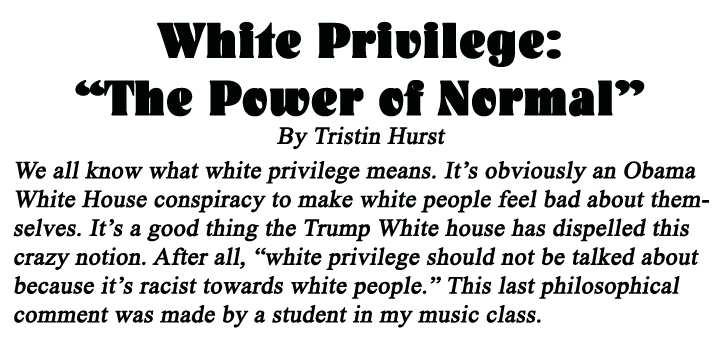
We all know what white privilege means. It’s obviously an Obama White House conspiracy to make white people feel bad about themselves. It’s a good thing the Trump White house has dispelled this crazy notion. After all, “white privilege should not be talked about because it’s racist towards white people.” This last philosophical comment was made by a student in my music class.
Two of my three-person music class group decided to create a music video as a long–term project. My Jewish female friend suggested the topic of the music video should be white privilege. My music teacher and I thought this was a great idea, but our third group member suggested we use a topic that won’t offend the white people who see the video. The three of us looked at him disdainfully and returned to our discussion. But the third student was insistent so my Jewish friend and I asked for clarification.
The third student’s point was that white privilege is not a sincere cause because not all white people are racist. I re-plied that I wasn’t certain that he really understood what white privilege means. He responded that he is not an idiot and knows what white privilege is. He stated that he understands what I go through as an African American male (Really?!), but classifying it as white privilege is not the way to reach people. I muttered to myself that white privilege meant that I had to deal with people like him every day.
But after class, my friend and I discussed the third student’s comments. The fact was, our third group member wasn’t trying to come off as ignorant or offensive; there are just a lot of holes in his knowledge about these topics. Without education, it is not easy to understand that you don’t have to be racist to benefit from white privilege. White privilege is not about the idea that all white people are racist, that white people didn’t earn what they have, or that they haven’t struggled themselves. White privilege is about the subtle things white people don’t have to experience but which weigh people of color down every day. In his article, “What is White Privilege, Really?” Cory Collins describes white privilege as “a weightless knapsack–and a weapon. It depends on who’s carrying it.”
White privilege involves the advantages that white people have that they did not earn, which people of color do not experience. But what are these advantages? One example that hits home is the privilege of being relieved as a law-abiding citizen when you see a police officer pull over if your car breaks down. For law-abiding people of color, seeing this same officer triggers anxiety because it could mean anything from help to threat, to unwarranted arrest or murder.
A less intense example of white privilege is the power of being part of the normal―for example, having your race widely represented in movies and on television shows. Even today, there are shows that have no people of color or display most black men as evil. I have recently watched the portrayal of every black man in the first five seasons of Supernatural in the same sickly fascinated way I would watch an oncoming train wreck: every single black man (not an exaggeration) has been a threat to the two white male heroes, even the black demon-hunter, the black angel and the black FBI agent. My friends watch Supernatural and see people who look like them portrayed in the full range of hero to neutral to villain. But in every episode, just as I start getting into the storyline, another bad black guy pops up, snapping me right back into my reality of how I am viewed as a black male by much of white America.
The power of normal is not having to search for the section of black hair products in the supermarket. The power of normal is not having to wonder if the store clerk is saying hello as code for I’m watching you or because he really is just trying to welcome you to his store. The power of normal is opening a first aid kit having flesh colored band-aids that match your skin tone. The power of normal is not having to go to the multicultural section of the grocery store to find your regularly used items.
For me, the power of normal is not having a white male teacher think it’s a good idea to nick-name you Trick Daddy while giving the white students nick-names that involve their actual names. White privilege is not being the only brown person in the class when a well-intentioned teacher plays an outdated podcast on black test anxiety (which I don’t have). The power of normal is not being the only person whose haircut isn’t noticed in an all white class. White privilege is not having a classmate tell you he will buy you a one-way ticket to return to Africa, and not just to visit. The power of normal is not having your art teacher telling you that maybe the Black Panther comic book produced in the 60s wasn’t as popular as the recent movie because it just wasn’t that good since things weren’t so bad for blacks back then. White privilege is being able to say that you are not an idiot and know what white privilege is when you have never viewed one single article, book, lecture, seminar or authoritative source defining white privilege.
I told my Jewish friend who proposed the white privilege video that rather than get overly upset about the third student’s failure to understand white privilege, perhaps we should do a middle/upper school seminar about black history and white privilege. After all, showing my disdain and calling him ignorant might make me feel better in the moment, but it isn’t going to change his perspective. It’s just going to shut him down, and I will have to suffer through more of his ignorance over the next several years. I convinced a few more of my school friends to get on-board with my idea of a seminar. Together, we obtained the approval of our Academic Dean to have a day where we fill in some of the gaps. Although I get frustrated by individuals in my school, I am very lucky to attend a school where the administration is 100% supportive of creating leaders who fight bigotry rather than promote it. I’m not so naive as to think our seminar will reach all my peers, but maybe it will be more effective for people like the third student in my music group, who really doesn’t want to be ignorant and insensitive, but needs information presented in a non-threatening and non-accusatory way in order to get it. ■